Artificial Intelligence (AI) for Social Good: Building the Future with AI
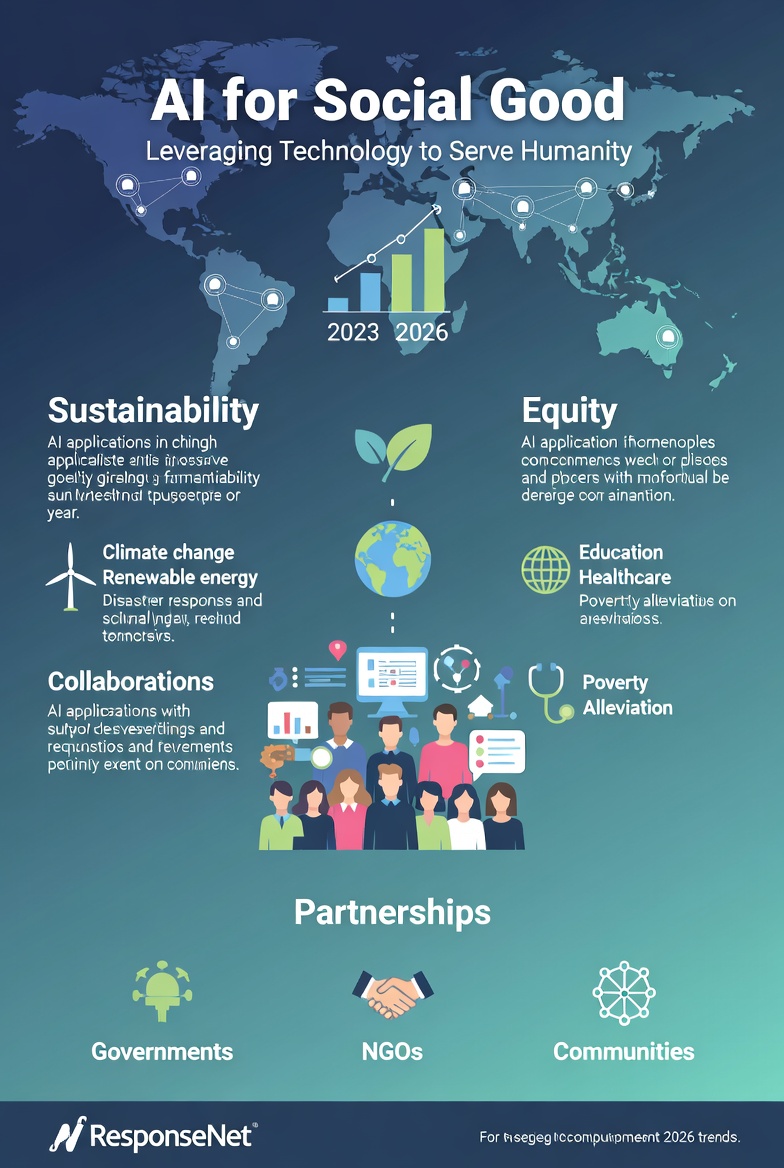
In an era where technology evolves at breakneck speed, artificial intelligence (AI) emerges as a transformative force with the potential to drive positive societal change. While discussions often highlight risks like job displacement and ethical dilemmas, this series shifts the focus to AI's role in fostering equity, justice, and sustainability. As we enter 2026, AI adoption in the nonprofit sector is accelerating, with 47% of professionals already saving 1-3 hours weekly through AI tools, and 56% planning further adoption. This momentum underscores AI's shift from experimental pilots to core infrastructure in social good organizations.
"AI for Social Good: Building the Future with AI" explores how AI can tackle global challenges such as climate change, healthcare inequities, education access, and poverty alleviation. With the global AI market projected to contribute $15.7 trillion to the economy by 2030, nonprofits and impact-driven entities are leveraging AI for enhanced efficiency and measurable outcomes. This optimistic lens positions AI not as a threat, but as a collaborative partner for humanity, especially in sustainable development goals (SDGs).
Beyond the tech, this series centers on the people shaping and benefiting from AI. It inspires corporate leaders, investors, policymakers, philanthropists, and changemakers to harness AI ethically for societal benefit. Through case studies, expert analyses, and actionable insights, we provide a blueprint for integrating AI into corporate social responsibility (CSR) initiatives, impact investing strategies, and nonprofit partnerships.
As you explore this content, remember: AI for social good is a collective call to action. In 2026, with agentic AI systems expected to handle 15% of routine decisions autonomously by 2028, it's time to redefine technology's role in serving humanity. Join us in creating a world where AI amplifies equity and sustainability.
Key Trends in AI for Social Good in 2026
Drawing from recent reports and projections, here are updated trends shaping AI's impact:
| Trend | Summary |
|---|---|
| AI as Organizational Infrastructure | Nonprofits are institutionalizing AI, reshaping job descriptions and workflows. Larger organizations (revenues over $1M) adopt AI at twice the rate of smaller ones, saving 15-20 hours weekly on administrative tasks. This addresses the "AI gap," urging shared resources for equitable access. |
| Agentic and Green AI | Agentic AI evolves from tools to autonomous agents, reducing burdens in mission delivery like workforce development and climate resilience. Sustainability is key, with AI projected to cut global emissions by 3.2-5.4 gigatonnes of CO₂ equivalent annually by 2035, offsetting data center energy demands doubling by 2030. |
| Ethical Governance and Sovereignty | Updates to standards, like Social Current's COA Accreditation revisions in spring 2026, emphasize human oversight and transparency. Sovereign AI initiatives reduce foreign tech dependence, with investments like India's $1.25B in multilingual models. |
| Impact on SDGs | AI boosts healthcare (market to $504B by 2032 with 90-95% diagnostic accuracy), education (personalized learning for 250M out-of-school children), and agriculture (precision farming reducing 40% crop losses from pests). |
| Funding and Collaboration | 63% of funders prioritize collective outcomes, with 86% advising stringent data hygiene for AI tools. "Outcome-as-a-Service" appeals to 48% of nonprofits, shifting from SaaS to AI-driven results. |
Explore the Series
Dive deeper into AI's applications for sustainable impact:
| # | Topic |
|---|---|
| 1 | AI in Sustainability and Climate Change |
| 2 | AI in Sustainable Mobility |
| 3 | AI for Disaster Preparedness and Response |
| 4 | AI in Water and Water Resources Management |
| 5 | AI for Economics |
| 6 | Wildlife Conservation and AI |
| 7 | AI in Agriculture and Food Security |
| 8 | AI for Sustainable Urban Planning |
| 9 | AI for Waste Management and Enhanced Recycling |
| 10 | AI in Policy and Governance for Sustainability |
FAQs: Addressing Common Questions on AI for Social Good
To optimize for search and provide value, here are answers to frequently searched queries:
| Question | Answer |
|---|---|
| What is AI for social good? | AI for social good refers to using artificial intelligence to address societal challenges, promoting equity and sustainability. In 2026, it's integral to nonprofit operations, with 77% of companies exploring AI. |
| How can corporations partner with nonprofits on AI initiatives? | Corporates can fund AI tools, provide expertise, or co-develop projects. Impact investing in AI yields returns through CSR alignment, with 84% of professionals emphasizing human-centered personalization. |
| What are the ethical considerations in AI for nonprofits? | Key issues include bias mitigation, data privacy, and human oversight. New regulations like the EU AI Act and South Korea's AI Basic Act (effective 2026) guide responsible use. |
| How does AI impact job creation in social sectors? | While AI may displace 85 million jobs by 2025, it creates 97 million new ones, netting 12 million gains, focusing on AI literacy and ethical roles. |
| What trends should investors watch in AI for social impact? | Look for green AI, agentic systems, and sovereign AI. Projections show AI reducing disaster costs by $70-110B annually by 2050. |
Recommendations for Getting Started
| Recommendation | Details |
|---|---|
| Assess AI Readiness | Use tools like Microsoft's AI Readiness Wizard or TechSoup's reports to evaluate your organization's capacity. |
| Prioritize Ethical AI | Adopt frameworks from ITU's Green Digital Action for sustainable deployment. |
| Build Partnerships | Collaborate with entities like AI for Good Foundation for SDG-aligned projects. |
| Invest in Skills | Train teams on AI literacy, as 39% of job skills will change by 2030. |
| Measure Impact | Shift to "Outcome-as-a-Service" for data-driven results, appealing to funders. |
Call to Action: Partner with ResponseNet for AI-Driven Impact
As a leading nonprofit, ResponseNet invites corporates, investors, and clients to collaborate on AI for social good projects. Whether through funding, tech donations, or joint ventures, your involvement can amplify sustainable outcomes. Contact us to discuss partnerships, CSR integrations, or impact investments.
Write to us: [email protected]
Keywords for Search and Outreach: AI for social good, nonprofit AI partnerships, corporate social responsibility AI, impact investing in AI, sustainable AI trends 2026, ethical AI nonprofits, AI in climate change, AI for SDGs, green AI initiatives, agentic AI social impact, AI governance for sustainability, nonprofit technology adoption, AI equity in social sectors.